White-Label Portal Framework for Multi-Carrier Distribution
Designed a scalable white-label system serving admin, producer, and member users across three carriers simultaneously. From a single foundational framework built on top of an existing codebase, with no design culture or precedent to start from.
The Arc
The Opportunity
Three carriers. Manual processes. No connected portal infrastructure.
The Work
White-label framework. Permission hierarchy. Mobile-first for field workers.
The Shift
Three carriers live. One system. New carriers onboard without a full rebuild.
The Opportunity
No portals. Manual everything. Three carriers depending on it.
Sydney Administrators didn't have a portal product. Our largest carrier client was running heavily on manual processes — paperwork, fragmented internal tools, nothing connected. Admin, producer, and member interactions were all handled separately through non-digital or semi-digital means.
The ask was significant: design a white-label digital framework built for one carrier that quickly became a product scaled across three. A single foundational system supporting three distinct user types. Administrator, producer, and member. Each with different permission levels, different workflows, and different definitions of what "success" looked like.
The People
Two authority structures. One design direction.
Internal team: I managed a product designer, a marketing lead, and an implementation lead — lean by design, with clear ownership across the functions that mattered most for launch.
Development side: An off-shore team consisting of a product owner, platform architect, UX designer, UI lead, and five software developers. Not direct reports. Design direction and all design decisions owned by me. That distinction matters. Setting direction across an off-shore build team without formal authority is exactly the environment I was built for.
External phase: Carrier stakeholders engaged once the internal foundation was solid. Compliance lived on both sides. The carrier and internally at Sydney Administrators. Navigating that dual compliance layer while maintaining design integrity was a sustained alignment challenge throughout.
"An off-shore team of nine. Not direct reports. I set design direction and owned every design decision. Leading without formal authority across time zones is exactly the environment I was built for."
The Work
Systems decisions first. Design decisions second.
The framework serves four distinct user types, each with their own portal, permission scope, and definition of success. Sydney Connect is the origin point. From there, Sydney Administrators works alongside carriers — our direct clients — to co-manage the admin portal. We handle third-party administration. The carrier configures what their channels need. Once that's in place, carriers receive the permissions to manage everything downstream: the producer portal for their broker and agency layer, the group portal for employer group administrators, and the member portal for the end user. That last one is where every decision made above it ultimately lands.
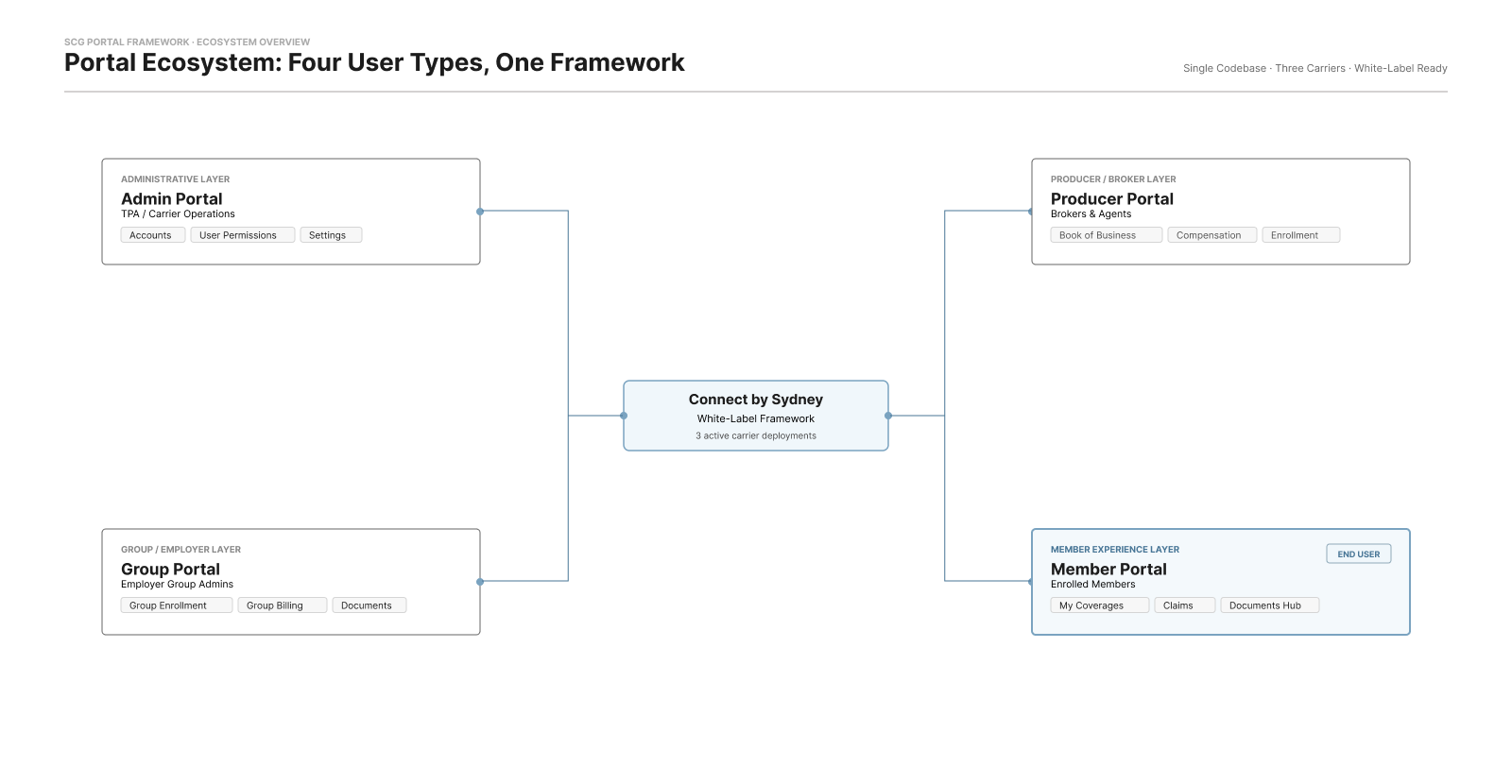
Portal ecosystem. Four user types served by a single foundational framework, each carrier receiving a fully branded instance on deployment.
Sydney Connect is the foundation everything else is built on. As the third-party administrator, Sydney Administrators operates from Sydney Connect — the central hub where carrier clients are onboarded, permissions are configured, and portal access is turned on or off. Carrier portals, producer portals, member portals: none of them exist until Sydney Connect enables them. This was a systems architecture decision before it was a design decision. The UX was built on top of a permission hierarchy that had to be right before anything else could be.
The hardest part wasn't the stakeholders. It was the gap between design and build. Concepts don't survive implementation by accident. I stayed close to execution, reviewed constantly, held the standard. Not because of ego, but because the end user on the other side of that screen deserves it.
One decision I'm proud of: The offshore team brought an existing codebase that compressed the timeline. Right call for velocity. But their framework was built for office workers, and the mobile experience showed it. I made the case for mobile-first, ran additional stakeholder interviews, and what came back reframed the product entirely. One carrier's employer clients had a workforce made up predominantly of field workers. Not desk-bound. Mobile was the only screen that mattered to them. That insight reshaped the MVP in ways the existing framework wasn't designed to accommodate. We pushed for it anyway. That's the HCD reflex. Not a workshop output. A real product decision made because someone did the research and held the line.
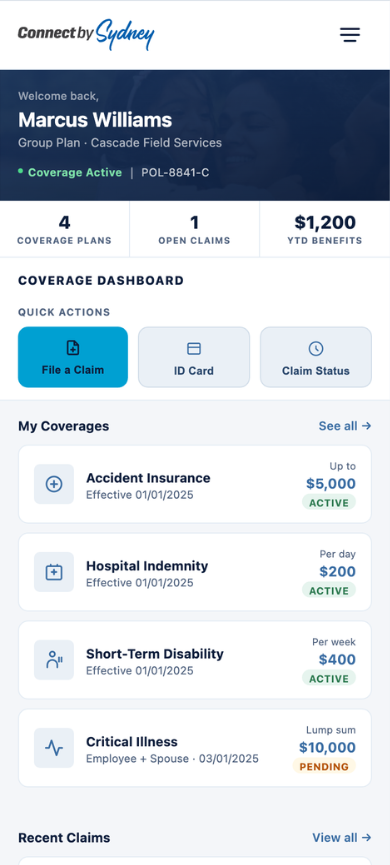
Member portal. Mobile web (Sydney Connect). Field workers get coverage status, quick claims filing, and plan details in a single scroll. Designed around the insight that this carrier's members are out in the field, not at a desk.
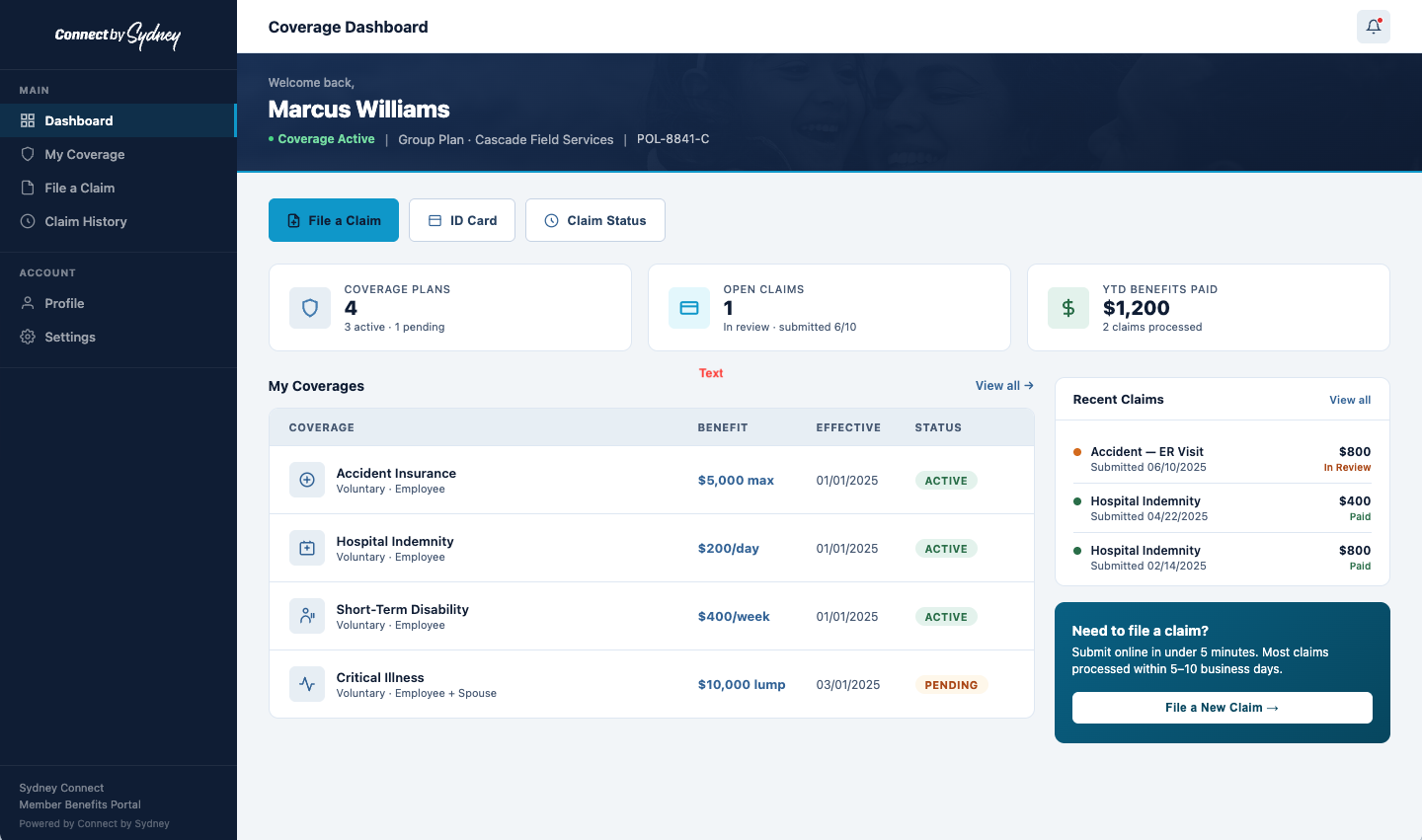
Member portal. Desktop (Sydney Connect white-label). The same component architecture as the base framework, carrier-branded at the configuration layer. Sidebar, hero, and coverage table all pull from Sydney Connect's brand tokens. No rebuild between carrier instances.
The Shift
Three carriers live. A living system that keeps iterating.
Three carriers launched. Large commercial books of business now have a connected digital experience where there was none before. The framework is a living system. New carriers onboard into existing infrastructure without a full rebuild.
We made scope concessions in the first iteration, intentionally, because a focused launch delivered on time is worth more than a feature-complete launch that misses the window. The carriers said so directly. What we shipped was on time, as promised, in a delivery window that was non-negotiable.
"That's the model. That's what I'm bringing to a team that is, by its own description, one month into building something new."
3
Carriers Live
4
Portal Types
1
Foundational System