Purpose-Built Pipeline Platform for Supplemental Insurance Distribution
Carrier clients were managing their entire sales pipeline through spreadsheets and Word documents. The Opportunity Tracking System replaces that manual lifecycle with a centralized, automated platform, serving carrier admins and the Sydney team simultaneously, from a single dual-org system.
The Arc
The Opportunity
Manual proposal lifecycle. Days per prospect. Two organizations absorbing the cost.
The Work
Purpose-built platform. Dual org. Five-tier permissions. MVP discipline.
The Shift
Manual chaos replaced by structured, carrier-aligned digital system. Fall 2026 launch.
The Opportunity
Purpose-built for a market that off-the-shelf tools forgot.
At Sydney Administrators, we were managing the full proposal lifecycle on behalf of our carrier clients: quoting, tracking, reporting. Every piece of it was manual. When a new prospect entered the pipeline, it was all hands on deck. Multiple people across multiple teams. Excel spreadsheets running rate calculations. Proposal templates updated by hand. Client managers pulling reports manually. Days of coordinated effort per prospect.
Before committing to a custom build, we evaluated what existed: pipeline tools, CRMs, Salesforce-adjacent platforms. None of them mapped to the reality of supplemental insurance worksite distribution. The workflows are different. The relationships are different. The proposal structure is different. Off-the-shelf tools weren't built for this market.
So we built it. Purpose-built, from the ground up. The Opportunity Tracking System (OTS) started with the first client as the proving ground. But the "this should scale" realization came before that engagement was finished.
The People
Two organizations. Executive skin in the game on both sides.
Sydney side: myself as design lead, our Head of Operations, our Client Relations Director, and our company founder. Lean and senior across the board. Carrier side: VP of Program Management and Strategy. Day-to-day input and feedback throughout the build. When decisions were significant enough, both presidents were at the table.
One dimension worth naming specifically: our Client Relations Director was both a stakeholder and a user. She manages the pipeline and reporting on behalf of our carrier clients. She's doing the work OTS is being built to replace. Her requirements had to be balanced against what the carrier needed on their end and translated into a design that served both simultaneously.
Development side: an offshore team of roughly eight to ten: engineers, architects, a UX designer, project management. I built the initial wireframes and proof of concept in Figma. Once direction was established and validated, I transitioned execution to the vendor's UX designer. Retained strategic oversight throughout.
"Set the vision. Build the proof. Hand off execution. Never hand off ownership."
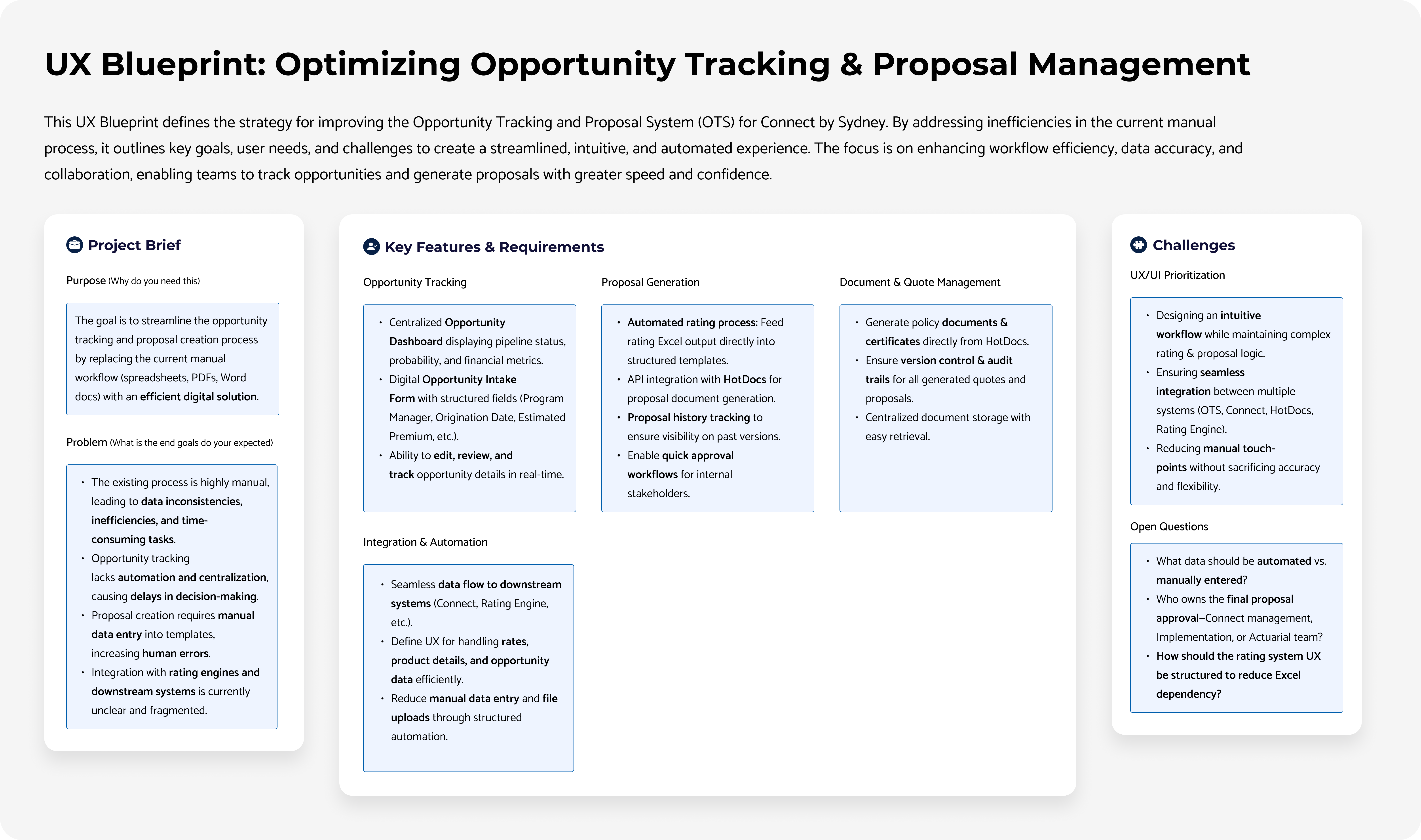
UX Blueprint. The strategic alignment document that preceded every wireframe. Goals, user needs, key features, and open questions mapped before a single screen was designed.
The Work
Don't build for the vision at the expense of the launch.
IA designed and documented. Sitemap covers Login/Auth → Dashboard → Leads → Opportunities → Tasks → Reports → Settings. Lead-to-opportunity conversion logic built into the UX: when a lead's status changes to "qualified" it converts to an opportunity. Business rule translated into a UX flow.
OTS serves both carrier admins and the SCG TPA team within a single platform, differentiated by a five-tier role-based permission system: System Administrator, Editor, Contributor, Reviewer, and Viewer, each with defined responsibilities. The IA was designed to account for the dual user base from the ground up.
The platform was designed for carrier-branded deployment from the start. The OTS interface in these wireframes is the base layer. Each carrier deployment replaces the color scheme and visual identity at the configuration layer. Same underlying system. Carrier-branded surface. The same white-label principle that runs through the SCG Portal Framework.
MVP scoping discipline was the hardest ongoing work. Desk research creates a temptation problem. Seeing what existing tools offer makes it easy to keep expanding scope. The discipline was pulling back consistently to the documented pain: proposal management, documentation workflows, the quoting and rating process. The hardest deferral was task management, the CRM-style layer. Right feature. Not the first feature.
The core proposal generation workflow runs six steps: lead entry, underwriting, rate production, proposal creation, broker/employer review, and signed upload. That sequence, previously distributed across spreadsheets, email chains, and manual coordination between SCG and carrier teams, is what OTS consolidates into a single tracked system.
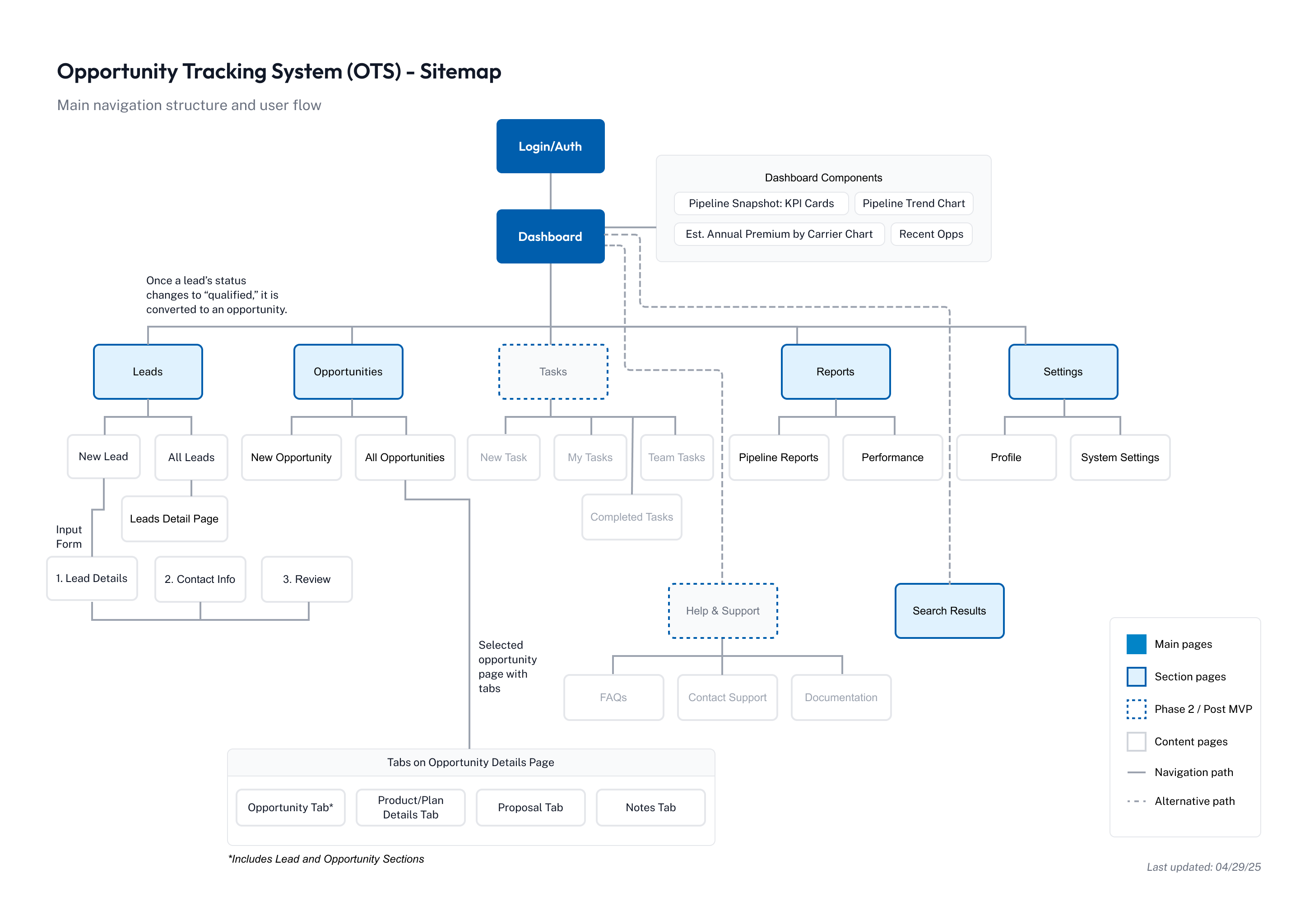
OTS platform sitemap. Navigation structure, lead-to-opportunity conversion logic, and Phase 2 scope boundaries. The full IA spans the UX Blueprint, permission hierarchy, and these screens together.
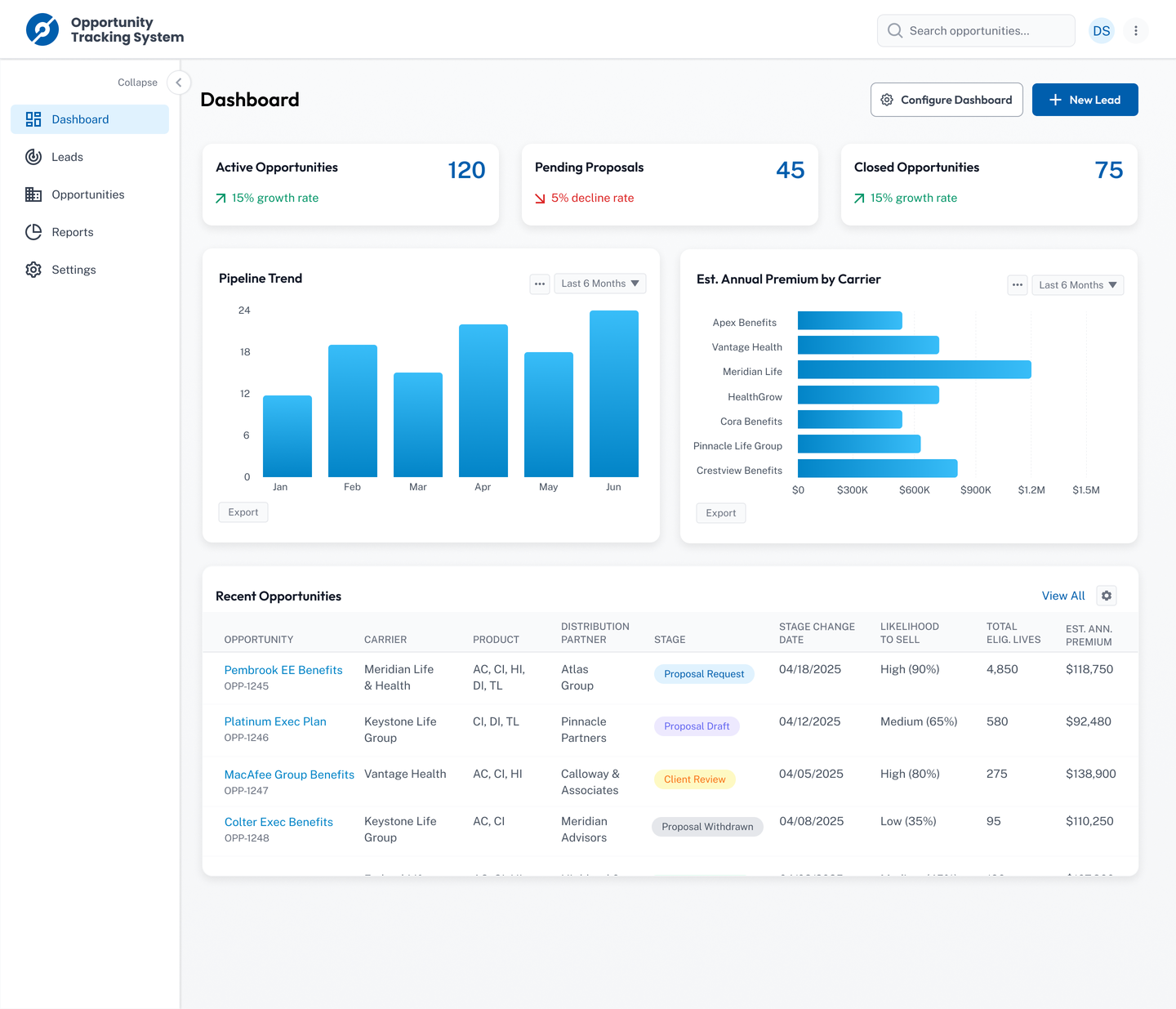
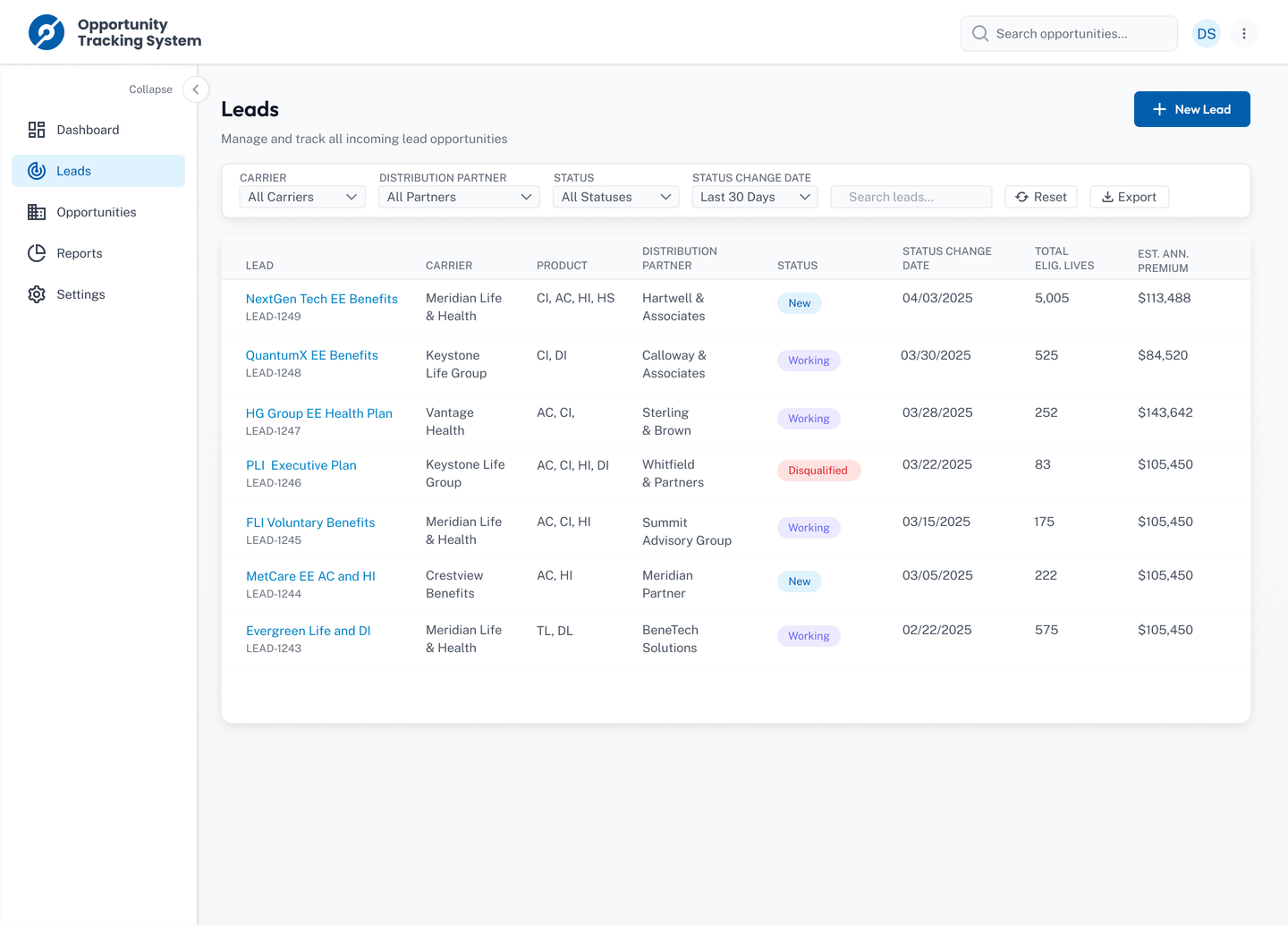
↗ Click to enlarge
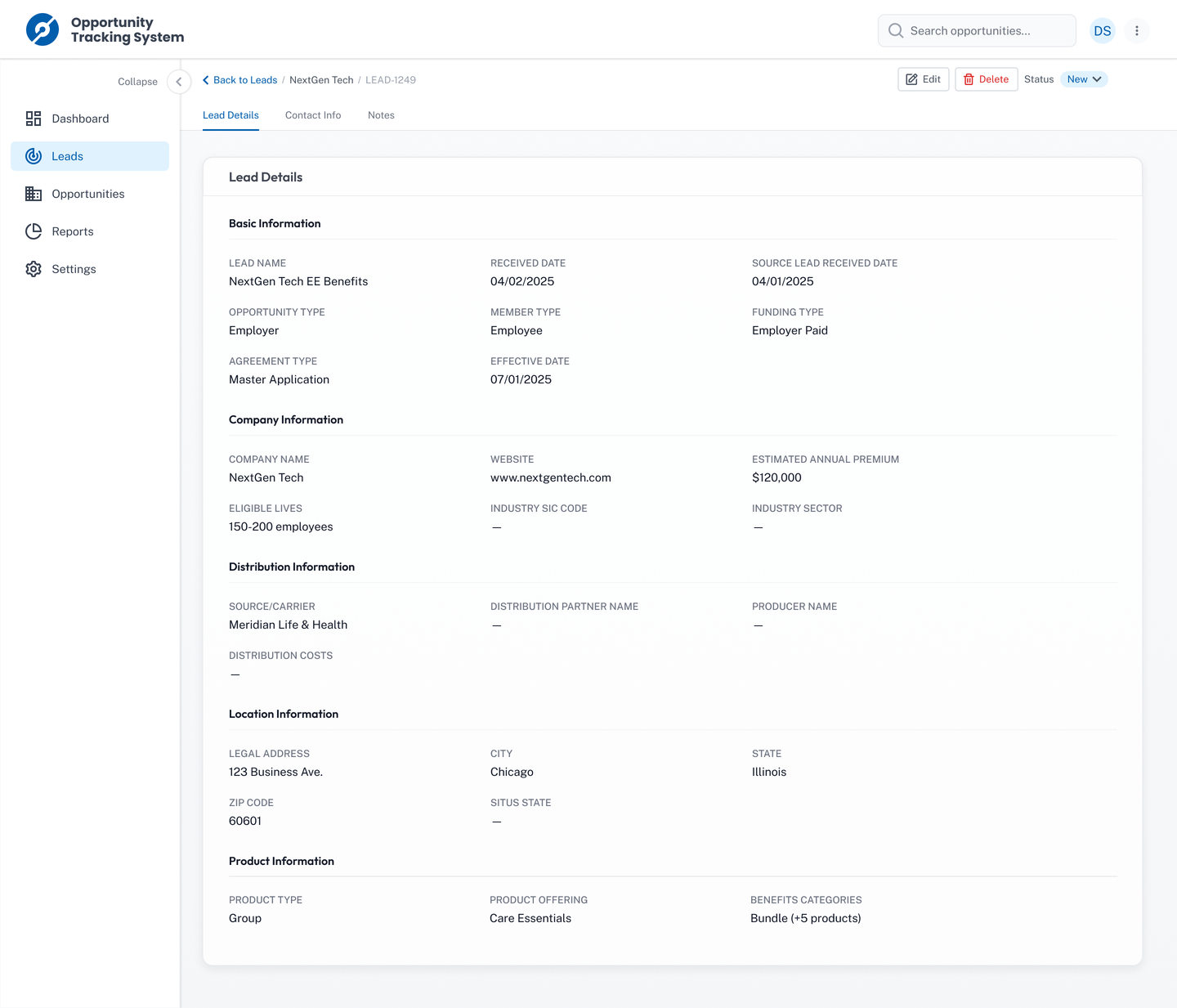
OTS wireframes. Pipeline Snapshot dashboard, Leads pipeline view, and Lead Detail screen. Built in Figma to establish direction before vendor handoff. Click any screen to expand.
The Shift
We didn't wait for the platform to start solving the problem.
This is an active build. The transformation is in the process itself. While the full platform build has been underway, the team built temporary automation solutions. Removing the manual proposal production process from the workflow entirely. The end-to-end manual process has been getting dismantled piece by piece, even before OTS ships.
MVP success is defined by three capabilities fully functional: proposal generation, documentation management, and the rating engine integration. Those are the highest-friction points. If those three are working at launch, the MVP has done its job. And the foundation is in place to scale opportunity management across the full client book.
UAT underway as of June 2026. Launch sequenced by carrier, first deployment in final preparation and second to follow. Design documentation actively guiding the build through each phase.
"We were already automating piece by piece. OTS is where all of that comes together into one place."
The Through Line
"I keep finding what got left out. The user the product forgot. The system a brand needed but never got around to building. Field workers, caregivers, administrators, teams building content without a shared standard to check it against. That's not a coincidence. That's how I'm wired to look at problems."